Capacitors are among the most fundamental components in electronics, playing a critical role in circuits ranging from household appliances to advanced industrial machinery. Whether you’re an electronics hobbyist, engineering student, or a professional, understanding capacitors can unlock the potential to design efficient and reliable circuits.
This article will explore capacitors in depth, covering their types, working principles, applications, and tips for choosing the right one.
Learn everything about capacitors, their types, working, applications, and future trends. A complete guide for electronics enthusiasts and professionals..
What is a Capacitor?
A capacitor is an electronic component that stores and releases electrical energy in a circuit. Unlike resistors, which resist the flow of current, capacitors store energy in an electric field created between two conductive plates separated by an insulating material called a dielectric.
In simple terms, a capacitor acts like a small rechargeable battery. It charges when connected to a power source and discharges energy when the circuit requires it. This unique capability makes capacitors essential in stabilizing voltage, filtering noise, and managing energy flow in electronic devices.
How Does a Capacitor Work?
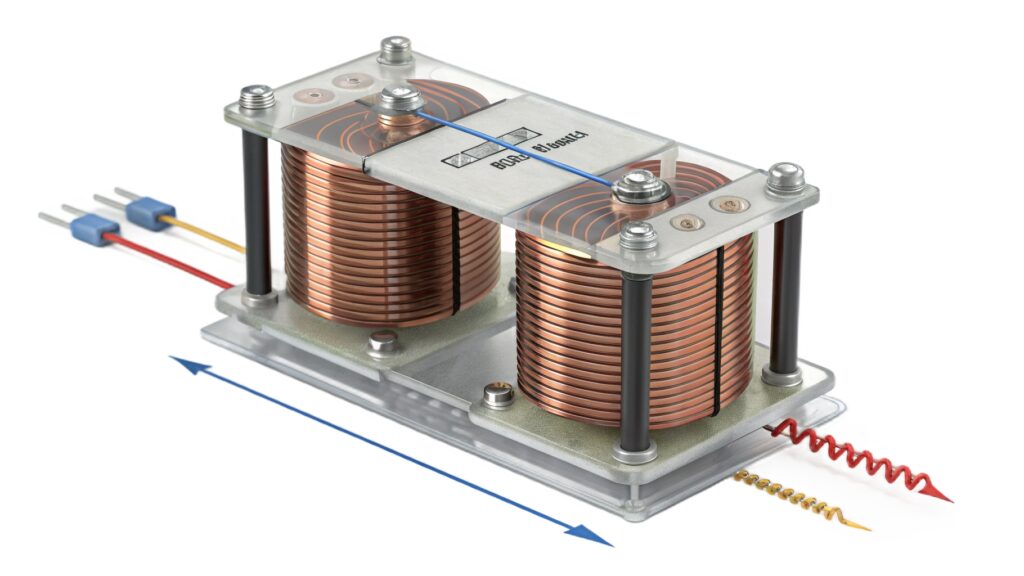
The working principle of a capacitor is based on electrostatic charge storage. When a voltage is applied across the capacitor’s terminals:
- Electrons accumulate on one plate, creating a negative charge.
- The other plate loses electrons, creating a positive charge.
- The dielectric between the plates prevents direct current from flowing, but it allows the capacitor to store energy.
The stored energy can then be released into the circuit when needed, making capacitors highly effective for energy smoothing, signal timing, and power regulation.
Key Formula for Capacitors:
C=QVC = \frac{Q}{V}C=VQ
Where:
- CCC = Capacitance (Farads, F)
- QQQ = Charge (Coulombs, C)
- VVV = Voltage (Volts, V)
Key Components of a Capacitor
A typical capacitor consists of three main parts:
- Plates: Usually made of aluminum or other conductive materials that store charge.
- Dielectric: An insulating material like ceramic, paper, or plastic that separates the plates.
- Leads/Terminals: Conductive wires that connect the capacitor to the circuit.
The dielectric type and plate area directly affect the capacitor’s performance, including its capacitance value, voltage rating, and energy storage capability.
Types of Capacitors
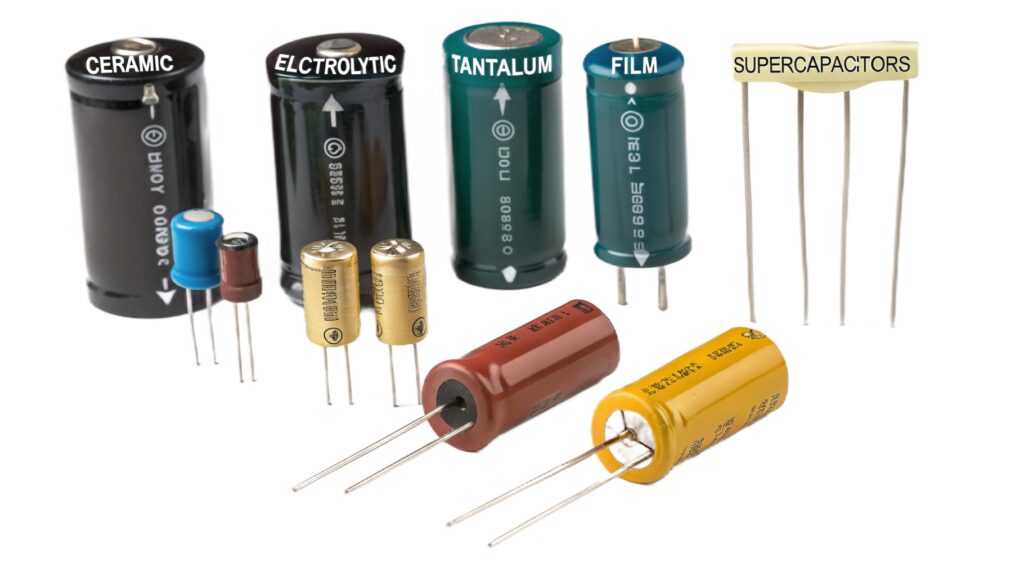
Capacitors come in various types, each suited for specific applications. Understanding the differences is crucial when designing electronic circuits.
Ceramic Capacitors
Ceramic capacitors are small, inexpensive, and widely used in electronic circuits. They have a ceramic dielectric and are commonly found in decoupling and filtering applications.
- Pros: Stable, low cost, non-polarized
- Cons: Limited capacitance (usually below 1 µF)
Electrolytic Capacitors
Electrolytic capacitors have a larger capacitance range (up to thousands of µF) and are polarized, meaning they must be connected correctly in a circuit. They are typically used in power supply filtering and energy storage.
- Pros: High capacitance, ideal for smoothing voltage
- Cons: Polarized, shorter lifespan than ceramic capacitors
Tantalum Capacitors
Tantalum capacitors offer high capacitance in a small size. They are stable and reliable for precision applications, especially in audio equipment and mobile devices.
- Pros: Compact, reliable
- Cons: Expensive, can fail catastrophically if misused
Film Capacitors
Film capacitors use a thin plastic film as the dielectric. They are excellent for high-frequency applications and AC circuits, providing precise capacitance values and low loss.
- Pros: Stable, long-lasting, high voltage tolerance
- Cons: Larger physical size for high capacitance
Supercapacitors
Supercapacitors (or ultracapacitors) have extremely high capacitance and can store large amounts of energy. They are increasingly used in electric vehicles, renewable energy systems, and backup power supplies.
- Pros: High energy storage, rapid charging/discharging
- Cons: Expensive, lower voltage tolerance
Capacitor Ratings and Specifications
When selecting a capacitor, you need to consider the following specifications:
- Capacitance (F): Amount of charge the capacitor can store.
- Voltage Rating (V): Maximum voltage the capacitor can handle safely.
- Tolerance (%): Acceptable deviation from the rated capacitance.
- Temperature Coefficient: Indicates performance variation with temperature changes.
- ESR (Equivalent Series Resistance): Low ESR is preferred for high-frequency and power applications.
Properly matching these ratings ensures safety, efficiency, and longevity of the circuit.
Applications of Capacitors
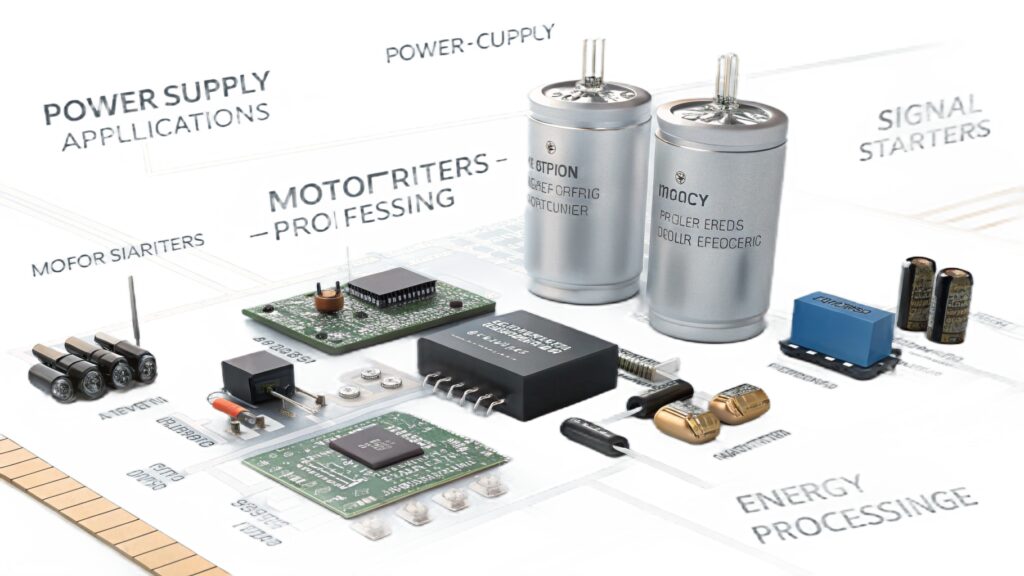
Capacitors have a wide range of applications in modern electronics.
Power Supply Systems
Capacitors are widely used in power supplies to smooth voltage fluctuations. They act as filters, storing excess energy and releasing it when the voltage dips, ensuring stable power delivery to sensitive electronic components.
Signal Processing
In audio and communication systems, capacitors filter and block unwanted signals, separate AC and DC components, and help in tuning circuits for desired frequencies.
Motor Starters
Capacitors are integral to single-phase AC motors. They provide the initial torque needed to start the motor and improve efficiency during operation.
Energy Storage
Supercapacitors are revolutionizing energy storage solutions. They are used in electric vehicles, grid stabilization, and renewable energy systems for rapid energy storage and discharge.
How to Choose the Right Capacitor
Choosing the correct capacitor depends on the circuit requirements:
- Determine the required capacitance and voltage rating.
- Consider the frequency of operation. High-frequency circuits need low-ESR capacitors.
- Check temperature tolerance if the capacitor will be used in extreme environments.
- Decide whether a polarized or non-polarized capacitor is needed.
By carefully selecting capacitors, you ensure optimal circuit performance and longevity.
Common Problems and Troubleshooting
Capacitors can fail over time due to:
- Overvoltage or reverse polarity
- Excessive temperature
- Aging and leakage
Symptoms of failing capacitors include circuit instability, bulging, or leakage. Regular inspection and testing using a multimeter or ESR meter can prevent unexpected failures.
Future of Capacitor Technology
The future of capacitors is exciting, with innovations like:
- Graphene-based capacitors: Ultra-high capacitance and energy density.
- Flexible capacitors: For wearable electronics.
- Hybrid supercapacitors: Combining batteries and capacitors for better energy efficiency.
As electronics continue to evolve, capacitors will play a critical role in energy management, miniaturization, and high-performance circuits.
FAQs
Q1: What is the main purpose of a capacitor?
A capacitor stores and releases electrical energy to stabilize voltage and filter signals in circuits.
Q2: Can a capacitor replace a battery?
Not entirely. Capacitors store energy temporarily, while batteries provide long-term energy supply.
Q3: Why do capacitors fail?
Common causes include overvoltage, overheating, aging, and incorrect polarity.
Q4: Are all capacitors polarized?
No. Only electrolytic and tantalum capacitors are polarized. Ceramic and film capacitors are non-polarized.
Q5: What is a supercapacitor?
A supercapacitor stores very high energy and can rapidly charge and discharge, ideal for backup power or electric vehicles.
Conclusion
Capacitors are indispensable in electronics, from basic circuits to advanced systems. Understanding their types, functions, and applications allows you to design reliable, efficient, and high-performance circuits. With emerging technologies like supercapacitors and graphene-based designs, the future promises even more powerful and compact energy storage solutions.